
It's 2026. Quiet Luxury Is Over. I've Written a 26 Page Interior Design Ebook on What's Replacing It.

I have spent the Spring thinking and writing about what's next for interior design in 2026, and the conclusion is unusually clean for a year ahead: quiet luxury is over.
Almost every major British paint brand has signed off the cool grey era. The dining room is back. The double bed has been quietly retired to the spare room. Brushed nickel is overtaking brass at the kitchen tap, and Pantone's Cloud Dancer off-white has been openly disputed by the British paint industry. There is a clear new aesthetic coming through, and after months of working through specifications with clients, I wanted to put it all in one place.
So I've written a 26-page guide to UK interior design trends for 2026, and you can get a free copy by emailing me, using the details below.
Found luxury, and why it matters
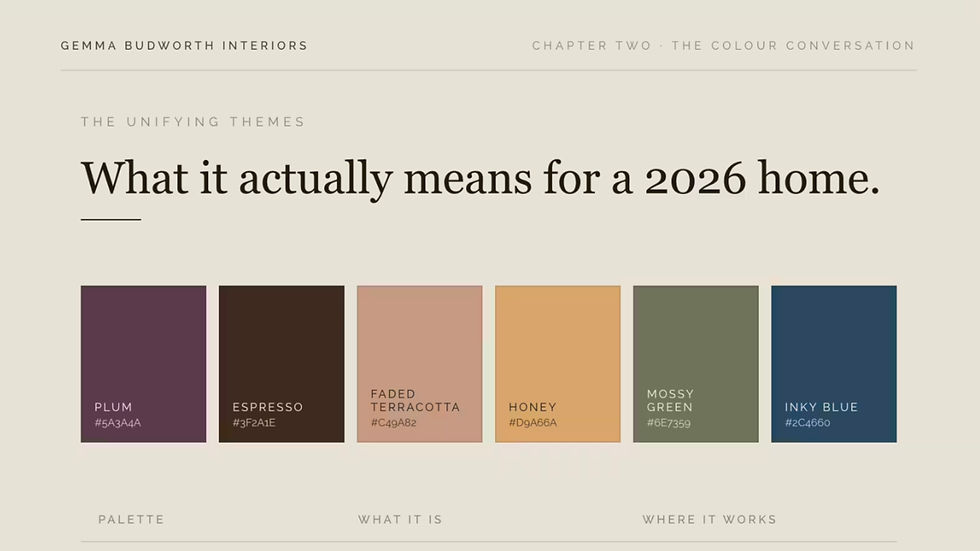
The shift the British editorial press is now describing is found luxury: warm, layered, characterful rooms that look collected over decades rather than commissioned in a season. Hugh Metcalf at Livingetc puts it crisply – the new luxury is about intention, not excess. Charlotte Olby at Homes & Gardens talks about homes with heart, layered and full of personality.
It is the opposite of beige restraint. Decorative pattern is back. Hand-painted murals are everywhere in the editorial press. The 1stDibs 2026 Designer Trends Survey found that 36 per cent of all designer-sourced items in 2025 were vintage or antique, the highest figure since 2021. Tom Howley reports wood finishes up 64 per cent over six months. Pale Scandi-bleached oak is on the way out; walnut, smoked oak and dark mahogany are rising. The rooms I am specifying for clients in 2026 are warmer, more textured, more committed and quietly more confident than anything I was specifying two years ago.
Found luxury is the lens that holds nearly every 2026 trend together. The warm earthy palette, the broken-plan reversal of the 2010s open-plan extension, the formal dining room's return, the rise of the snug, the embedded hybrid-working spaces replacing dedicated home offices – all of them are downstream consequences of the same mood shift.
Why a guide rather than a blog post
There is no shortage of trend listicles for 2026. Most of them are right about something, wishful about something else, and contradictory in places. What I have not seen, anywhere, is a designer's straight-talking version: which trends will translate beautifully into a Victorian terrace, which paint colours I would specify without hesitation, which much-photographed looks I would gently steer you away from, and what the £15 billion Warm Homes Plan announced in January actually means for retrofitting a Georgian rectory.
That is what the guide is. Twenty-six pages, eight chapters, a frequently asked questions section at the end, and a colour palette table you can take to a paint shop.

What's inside
The eight chapters are:
The Mood – the macro themes shaping 2026
The Colour Conversation – why there is no single colour of the year, and the five major British picks compared
Materials, Finishes and Texture – stone, wood, metals and the return of decorative pattern
Room by Room – kitchens, bathrooms, bedrooms, dining rooms, living rooms, hallways and boot rooms
How We're Living Differently – hybrid working, broken-plan and the dining room's return
The Designers Setting the Agenda – the British names worth following this year
The Bigger Picture – sustainability, vintage and the EPC C deadline
What's Quietly Retired – the looks I am gently steering clients away from
Plus a frequently asked questions section answering the seven specific questions clients have asked me most often this autumn, from the Pantone debate to whether colour drenching has run its course (it hasn't, but it's warmer now).
A few of the opinions inside
Three takes from the guide, in case you want a flavour of the writing before you commit your inbox to it.
On the colour of the year. There isn't one. The British paint industry has fragmented into at least five separate picks: Dulux's Rhythm of Blues trio, Little Greene's Adventurer (a regal plum-aubergine, and probably my favourite of the five), Farrow & Ball's twelve-colour palette led by Marmelo, and Benjamin Moore's Silhouette espresso brown. Pantone's Cloud Dancer is the global outlier and the British trade has openly disagreed.
On metals. Brass has had a long run. It is not disappearing, but if you are specifying a kitchen this year, brushed nickel is the cooler, deeper, less of-the-moment choice. Mix rather than match: nickel taps, aged brass cabinet pulls, blackened steel hinges. One finish should dominate at around 70 per cent of the metalwork in a room.
On open-plan kitchens. The 2010s extension is being quietly undone. Where a generation of British homeowners knocked every wall down to create one cavernous ground floor, the 2026 reflex is to put some of the zoning back. Crittall doors, internal glazing, half walls, pocket doors. The aim is to keep the light without losing the rooms.
Who it's for
Anyone working on a project in 2026, particularly in a Victorian, Edwardian or Georgian property where the brief is to honour the architecture while making the home work properly for the people living in it now. It is also useful, I hope, for anyone who has read three trend listicles and felt none the wiser about what to actually put on a wall.
How to get it
Email me: studio@gemmabudworthinteriors.co.uk and I'll send you a copy of the full 26-page guide. It's free, in exchange for your email address, and I will send you nothing else unless I have written something I genuinely think you would want to read. No discount codes, no daily newsletters, no automated sequences.
If anything in it prompts a question about your own home, I would love to hear from you.
Gemma Budworth is the founder of Gemma Budworth Interiors, a British interior design studio specialising in luxury homes. The 2026 UK Interior Design Trends guide draws on autumn 2025 announcements from Dulux, Farrow & Ball, Little Greene, Benjamin Moore, John Lewis and Tom Howley, alongside her own client specifications and project work.


