
Modern English Country Style 2026: A Designer's Definitive Guide | Gemma Budworth Interiors

If there is a single aesthetic that defines premium British interiors in 2026, it is Modern English Country.
Not the chintz-heavy, brown-furniture-stuffed country house of the 1980s, and not the slightly ironic Cotswolds-via-Instagram look that flooded social media around 2021. The 2026 evolution is something genuinely new: warmer, lighter, more characterful, more confident with colour, and built on the principle that an English country home should look like the family who live in it rather than a brand catalogue.
I specify in this aesthetic for the majority of my clients, and the conversation has shifted noticeably in the last eighteen months. Country Life's March 2026 Top 100 issue called craftsmanship the bedrock of distinctive design and central to the renaissance of the English country house. Houzz UK is calling the wider trend heritage maximalism. House & Garden's Noni Ware has flagged hand-painted murals, decorative pattern and bespoke fabric as the year's defining moves. What follows is my designer's guide to what Modern English Country actually means in 2026, who is leading it, and how to translate it into a real British home that may not have a paddock attached.
What is Modern English Country style in 2026?
Modern English Country is the contemporary evolution of traditional English country house style: warm, layered, characterful interiors that draw on heritage architecture, decorative pattern, antique furniture and hand-finished detail, but specified with the lightness, comfort and colour confidence of a modern family home. It is the dominant British premium aesthetic of 2026, and the frame that holds nearly every other trend of the year together.
The shorthand version: imagine a working farmhouse in Wiltshire that has been gently updated for a young family. The Aga is still there. The flagstones are still there. But the kitchen has a freestanding pantry rather than a fitted run of cabinets, the curtains are a hand-blocked floral rather than chintz, the sofa is a proper deep linen piece rather than something inherited from a great-aunt, and the walls are painted Adventurer rather than Magnolia.
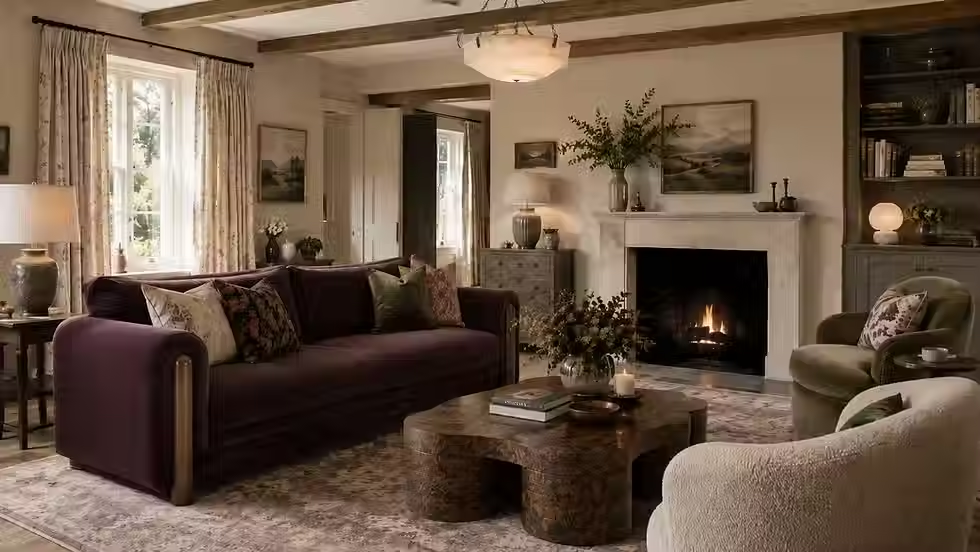
Ben Pentreath's four-word formula remains the genre's clearest definition: happiness, history, character, imperfection. What makes the 2026 version distinctly modern is what it adds to that formula - colour confidence, lighter scale, properly considered lighting, and a refusal to take itself too seriously.
How is Modern English Country different from traditional English country?
The two aesthetics share a vocabulary but produce very different rooms. The differences matter because they explain why traditional English country, beautifully done, can still feel slightly oppressive, while the modern version reads as warm and welcoming.
Traditional English Country | Modern English Country (2026) | |
Colour | Magnolia, sage, hunter green, burgundy | Plum, terracotta, indigo, mossy green, plaster pink |
Pattern | Heavy chintz, dark florals, tartan | Hand-blocked, suzani, paisley, contemporary florals |
Wood | All-mahogany, dark and uniform | Mixed - walnut, smoked oak, painted period furniture |
Upholstery | Chesterfield in dark leather, button-backed | Linen, velvet, layered cushions, mismatched pieces |
Lighting | Single brass chandelier per room | Multi-source, layered, alabaster pendants |
Pace | Frozen, museum-like | Lived-in, allowed to evolve |
The single biggest shift is in lightness. Traditional English country at its worst feels weighted down by history. Modern English Country admits the same history but frees the room to be lived in - colour confidence replaces colour caution, lighter upholstery replaces dark leather, and the rooms breathe.
What colours and materials define Modern English Country in 2026?
The 2026 Modern English Country palette is the warm earthy story that runs through every major British paint launch this year. Plum and aubergine (Little Greene's Adventurer is the year's most-specified shade in this family), faded terracotta and plaster pink (Farrow & Ball's Marmelo and Naperon), espresso brown (Benjamin Moore's Silhouette), indigo and inky soulful blues (Dulux's Rhythm of Blues trio), and the full range of mossy, olive and Reduced Greens.
What unifies them is warmth and depth. Cool greys, stark whites and saturated brights all sit awkwardly inside Modern English Country - the palette wants tones that feel lived-in, slightly faded, and naturally companionable to old furniture and old rugs.
Materials are where the 2026 version separates most clearly from the 1980s template
Wood: Walnut, smoked oak, mahogany and Tudor Oak - mixed rather than matched. Tom Howley reports wood finishes up 64.1 per cent over six months, led by Natural Oak then Tudor Oak. One characterful wood per room, not a uniform finish.
Stone: Honed limestone, Cappuccino travertine, Calacatta Viola, claret-veined slabs. Cool Carrara and grey porcelain are quietly retired.
Plaster and lime wash: Bauwerk lime washes, Tadelakt, Roman clay, microcement. Plaster reads beautifully under cool British light and partners exceptionally well with the warm 2026 palette.
Metals: Brushed nickel mixed with aged brass and blackened steel. The 70 per cent rule applies - one finish dominant, with one or two complementary metals as accents.
Textiles: Linen, wool, velvet, raw silk, hand-blocked cotton. Synthetic fibres read instantly wrong; the look depends on natural fibre.
Pattern: Suzani, paisley, hand-blocked floral, embroidery, jacquard, damask, moiré. Across Colefax and Fowler and Sanderson, the new fabrics are markedly more intricate than anything launched in the last five years.
The other defining material story is vintage. The 1stDibs 2026 Designer Trends Survey found that 36 per cent of all designer-sourced items in 2025 were vintage or antique - the highest figure since 2021. A Modern English Country room without at least one piece of genuine provenance reads thin. The vintage trade is not a flourish; it is structural.
Who are the British designers leading Modern English Country in 2026?
The most credible reference list draws from House & Garden's Top 100 (April/June 2025), Country Life's Top 100 with its 14 new names for 2026, and the British Institute of Interior Design Awards 2025. The thread that connects them is convivial English country style, recoded for a modern audience - not stuffy, not frozen, not slavishly heritage.
The established voices. Rita Konig is the genre's most influential contemporary practitioner; Country Life calls her "the goddess of small things," and her launch of Rita Konig Household Goods in 2026 alongside a second Schumacher fabric collection underlines her commercial reach. Ben Pentreath sets the editorial tone for the whole aesthetic; his four-word formula is now genre shorthand. Beata Heuman brings a more playful, pattern-confident voice. Sims Hilditch (B-Corp accredited and reliably good on sustainable specification) published Beautifully British Interiors in 2025 and is one of the clearest voices on how the look translates into family homes. Studio Ashby (Sophie Ashby), Rose Uniacke, Nicola Harding, Studio Peake, Salvesen Graham, Kit Kemp, Edward Bulmer (the most authoritative voice on heritage colour), Veere Grenney, Flora Soames (her Pimlico Road shop Kiosk opened in 2025), Octavia Dickinson, Retrouvius, Jamb and Max Rollitt round out the established roster.
The emerging names with serious 2025-26 momentum. Studio Squire, Vanrenen Hanbury (Sarah Vanrenen's Berkshire studio), Eadie & Crole, Nels Crosthwaite Eyre (formerly with Robert Kime), Olivia Outred, Brandon Schubert, John Tanner, Natalie Tredgett and Vawdrey House, who won the Anna Whitehead Prize for Sustainability at the BIID Awards 2025.
If you want a single shortcut to understanding the genre, the Instagram accounts of Pentreath, Konig and Sims Hilditch are the three I would follow first. Each represents a slightly different reading of the same aesthetic - Pentreath the most editorially refined, Konig the most personal and lived-in, Sims Hilditch the most translatable into a family house.
What are the principles of Modern English Country?
Six principles that underpin every Modern English Country room I specify. They hold across budgets, property types and rooms, and they are what separates a successful Modern English Country scheme from a pastiche of one.
One hero piece per room. Rita Konig's principle: a large floral on a sofa, a hand-blocked curtain, a single antique chest, a substantial piece of art. Build everything else around it. This is the single most important rule of the genre because it forces editorial restraint without flattening the room. A Modern English Country sitting room has one thing your eye lands on first; everything else is supporting cast.
Layer materials, not colours. Plaster wall, velvet sofa, worn leather armchair, wool rug, linen curtains. The temperature should be quietly varied throughout the room. Where 2024 layered colour, 2026 layers texture - matte against gloss, nubby against smooth, hand-glazed against honed.
Mix decades, not styles. A Georgian chest, a 1970s lamp, a contemporary sofa, an antique rug. Decades layer beautifully because they share a sense of time having passed. Competing styles - mid-century modern next to high-Victorian, for example - tend to fight rather than complement.
Allow imperfection. Hand-glazed tile that varies. A painting hung slightly off-centre. A lamp that has clearly been mended. The patina of a real leather armchair. Modern English Country rooms are forgiving, which is part of why they age so well. A polished room reveals every flaw; a layered room absorbs them.
Specify the lighting properly. A single overhead pendant in a Modern English Country room is almost always wrong. The genre calls for layered lighting - one statement central piece, two table lamps, a pair of picture lights above any artwork, a floor lamp in a reading corner. Five distinct light sources, all dimmable, all warm-toned (2700K or below). Pooky and Original BTC are widely specified at premium level.
Buy at least one piece with provenance. Not for show, but because every collected room needs at least one object you cannot find on the high street. The Decorative Antiques and Textiles Fair at Battersea Park is the obvious starting point - three editions are running in 2026. Lorfords, Max Rollitt and the regional dealers most country-house designers use are the next layer up.
How do I style a Modern English Country home in a city flat?
This is the question I am asked most often, and the answer is: the same principles, scaled. Modern English Country is not really about square footage or rural geography. It is about warmth, layering, and the willingness to mix old and new. A two-bedroom flat in West London can carry the aesthetic as confidently as a Cotswolds rectory, provided the choices are scaled to the architecture rather than imitating it.
Five adjustments for a city version of the look:
Smaller-scale pattern. A large-scale chintz that works on a country-house sofa overwhelms a city flat. Smaller-scale hand-blocked florals and stripes scale better to urban rooms.
Lighter wood tones. Walnut and mahogany absorb light, which works in a country house with deep window reveals but can feel oppressive in a city flat with smaller windows. Smoked oak or honey-toned woods read as a softer alternative.
Fewer furniture pieces, better quality. A country house can carry six pieces in a sitting room; a city flat usually wants four. The Modern English Country instinct is to choose fewer, better, more confidently.
One hero curtain rather than two. Heavy interlined curtains read as luxurious in a country house and fussy in a city flat. A single hero curtain - a hand-blocked print, a strong stripe, a linen with contrast trim - does more work than a matching pair.
More restraint with antiques. A country house can carry an antique in every room; a city flat usually wants one or two genuinely beautiful pieces, given space to be seen.
The principle that holds across both: specify like a country home, edit like a city flat.
Frequently asked questions
What is Modern English Country style?
Modern English Country is the contemporary evolution of traditional English country house style - warm, layered, characterful interiors drawing on heritage architecture, decorative pattern, antique furniture and hand-finished detail, but specified with the colour confidence and lightness of a modern family home. It is the dominant British premium aesthetic of 2026.
What's the difference between Modern English Country and traditional English country?
Traditional English country is rooted in dark mahogany, heavy chintz, and largely neutral walls. Modern English Country uses lighter scale, mixed wood tones, hand-blocked rather than chintzy patterns, layered lighting, and a confident warm earthy palette including plum, terracotta and indigo.
What colours define Modern English Country in 2026?
The warm earthy palette - plum and aubergine (Little Greene's Adventurer), faded terracotta and plaster pink (Farrow & Ball's Marmelo and Naperon), espresso brown (Benjamin Moore's Silhouette), indigo (Dulux's Rhythm of Blues trio), and the full range of mossy and Reduced Greens.
Which British designers should I follow for Modern English Country inspiration?
Ben Pentreath, Rita Konig, Beata Heuman, Sims Hilditch, Studio Ashby, Salvesen Graham, Edward Bulmer, Flora Soames, Max Rollitt and Retrouvius are the most widely cited. Emerging names include Studio Squire, Vanrenen Hanbury, Olivia Outred and Brandon Schubert.
Can I do Modern English Country in a city flat?
Yes. The principles travel - one hero piece per room, layered materials, mixed decades, layered lighting and at least one antique with provenance. The adjustments are mostly about scale: smaller pattern, lighter wood tones, fewer pieces, more restraint with antiques.
What's the easiest way to start a Modern English Country scheme?
Three moves: paint one wall in a confident warm shade (Adventurer, Marmelo or a mossy green), specify a hero fabric (a hand-blocked floral curtain or a small-scale pattern on an armchair), and add one antique piece with genuine provenance. Build the rest of the room around those three anchors.
If you want the full picture on 2026, including the warm earthy palette, the dining room's return and the broken-plan reversal, I have written a 26-page guide that covers all of it. You can find out more here.
Gemma Budworth is the founder of Gemma Budworth Interiors, a British interior design studio specialising in modern heritage homes.


